
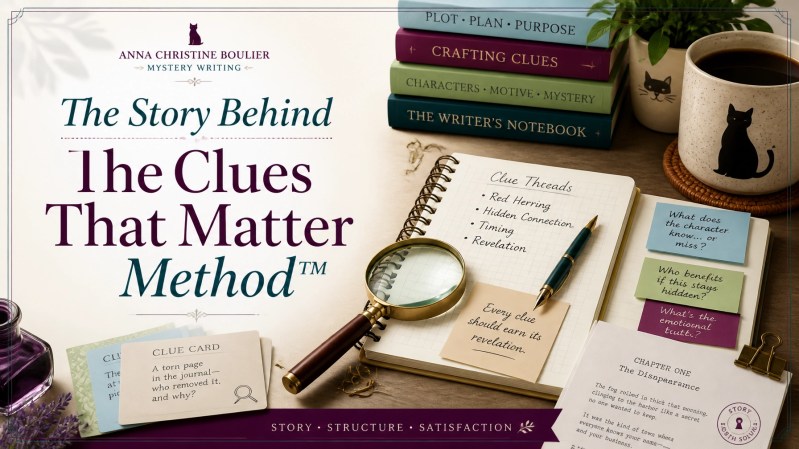
There’s a moment in every mystery when the story stops feeling like a tidy puzzle and starts feeling like a pile of socks pulled from the dryer, and nothing matches.
Some clues are important.
Some clues are red herrings.
Some clues are there because the author got excited and forgot to ask whether they belonged.
I know this because I’ve done it.
More than once.
And for a while, I honestly wondered if I was the problem.
When I began writing the Sam Sunday Mysteries, I knew what I wanted on the page.
I wanted an unusual detective duo. Sam Sunday is brilliant, grumpy, and a paraplegic. Reggie Lowes is his tattooed, mohawk-sporting nurse and partner in crime-solving.
I wanted two mischievous cats.
I wanted unexpected friendships, quirky settings, humor, hidden truths, and a mystery that invited readers to play along.
That sounds wonderfully organized, doesn’t it?
It wasn’t.
Behind the scenes, my writing desk looked less like a polished author workspace and more like a small investigation conducted by someone who had misplaced her own evidence.
I had notes everywhere.
A clue on one page. A character secret on another. A possible twist scribbled beside my hot chocolate. A timeline that made sense on Tuesday and absolutely refused to cooperate by Thursday.
And then there were the questions.
Who knew what?
When did they know it?
Why didn’t they tell anyone?
Was that detail a clue, or was it simply a detail I liked?
That last question caused me more trouble than I care to admit.
Sometimes writers fall in love with our own cleverness.
I’m no exception.
Before The Clues That Matter Method™ had a name, it had a backstory.
And that backstory included about three years of writer’s block.
Not the dramatic, movie-scene version.
The frustrating version.
The version where you keep showing up, keep trying, keep moving sticky notes around, and still cannot make the mystery behave.
I tried traditional plotting approaches.
Beat sheets.
Scene cards.
Timelines.
Color-coding that made me feel wildly productive right up until I realized I was still stuck.
Those tools work beautifully for some writers.
They just were not helping my brain solve the actual problem.
I didn’t need a prettier outline.
I needed a way to understand what each clue was doing and why it belonged.
That was the missing piece.
Not more paper.
Not more boxes.
Not more pressure to plot like somebody else.
God was kind in that season, even when I was stubborn.
He kept teaching me that frustration can become a lesson if we stay with it long enough.
A clue isn’t important simply because it’s interesting.
It matters because it does work.
That idea changed everything for me.
Readers deserve a fair chance.
Every clue needs a job.
A red herring should still reveal something true.
And the ending should feel inevitable in hindsight.
Not obvious. Not random.
Earned.

That’s the kind of mystery I love to read.
The kind where the ending surprises you without cheating you.
The kind where you can turn back through the pages and say, “Oh. I should have noticed that.”
The trouble is that creating that experience requires more than scattering suspicious objects and secretive conversations throughout a manuscript.
The clues need relationships.
They need timing.
They need purpose.
That realization gave rise to The Clues That Matter Method™.
At some point, I stopped asking, “What else can I add?”
Instead, I started asking, “What does this clue do?”
That small change made a surprisingly big difference.
Not because it magically turned me into a plotting genius overnight.
I would love to tell you that happened.
It did not.
But it gave me a better question.
And better questions tend to lead to better stories.
Once I began looking at clues through that lens, plotting became less about collecting interesting ideas and more about building intentional connections.
The mystery grew stronger.
My notes became easier to follow.
And I spent less time staring at a page wondering where I had hidden my own evidence.
That, friends, is a very low-tech but very real writing problem.
The Clues That Matter Method™ didn’t arrive as a perfectly designed system with a polished name and matching workbook.
It developed the way many useful things develop.
Slowly.
Through trial and error.
Through revision.
By discovering what was missing and creating a place for it.
I was not trying to invent a grand theory of mystery writing.
I was trying to stop losing the thread of my own story.
I needed a way to see the whole mystery without flattening its life out.
I needed to keep track of clues, secrets, reveals, and shifting suspicion without creating a system so rigid it strangled the fun.
I needed room for both structure and surprise.
Different stories.
The same heartbeat.
One of my favorite parts of the method is how it begins in a mess.
A real mess.
The kind with scribbled notes, half-formed suspicions, loose scene ideas, and one detail circled three times because apparently I did not trust myself to remember it.
That early Brain Dump matters.
Not because it is pretty.
Because it is honest.
Then, over time, the chaos begins to settle.
Part of that process became a four-part Clue Map built around Motive, Means, Opportunity, and Character.
I’ll save the full teaching for the presentation, handout, and workbook.
But those four categories gave me a way to look at a mystery and finally see what belonged where.
If you’ve ever watched an old-school mystery unfold and thought, this is delightfully ridiculous, but somehow all these weird little details connect, you already understand the appeal.
A messy brainstorm can become much clearer when you group the right clues in the right way.
That was a game changer for me.
Another part of the method became what I call the Five Question Test.
I’m not going to unpack the whole thing here.
That material belongs in “Murder, Mischief, & Making It Make Sense,” the handout, and the workbook still in development.
But I will say this.
The test helped me stop treating clues like decorative accessories.
It helped me notice when something was interesting but not useful.
It helped me see when a red herring was clever but not honest.
And it helped me build toward endings that felt surprising at first glance and inevitable on the second look.
Sometimes the biggest writing breakthrough is not getting more ideas.
Sometimes it is learning how to test the ideas you already have.
The Clues That Matter Method™ helps writers see a mystery as a connected story, not a series of isolated surprises.
It is also the foundation behind my Sisters in Crime Atlanta presentation, “Murder, Mischief, & Making It Make Sense.”
That presentation gave me a chance to talk through the method with fellow mystery writers who understand exactly how fast a promising plot can turn into a wall of sticky notes and regret.
What I love most about this method is that it protects more than the puzzle.
It protects the reader’s experience.
It protects fairness.
It protects the emotional story underneath the clues.
Because cozy mysteries aren’t only about finding out who committed a crime.
They’re about people.
They’re about trust and betrayal, loneliness and friendship, grief and healing, courage and second chances.
The mystery gives us a reason to keep turning pages.
The characters give us a reason to care.
I love the puzzle of a mystery.
I also love the cup of something warm beside the puzzle.
For me, the writing process has always included both.
The careful planning.
The unexpected discovery.
The practical notes.
The characters who decide they have better ideas than I do.
And, naturally, the occasional snack break that lasts longer than planned.
The Sam Sunday Mysteries carry that same balance. Secrets to uncover and questions to answer, but also cats, humor, friendship, and the small human moments that keep the story from becoming only a mechanism.
A well-plotted mystery can still feel warm.
A hopeful story can still hold tension.
A funny character can still carry real pain.
That balance matters to me because it reflects life.
Even in difficult seasons, God often meets us in ordinary places.

A conversation.
A shared meal.
A loyal friend.
A detail we almost overlooked.
Sometimes grace looks like a second chance.
Sometimes mystery looks like one small clue that finally makes sense
For a long time, I kept these plotting tools in my own notebooks and working files.
Private little systems.
Messy pages.
Half-legible notes that made perfect sense to me on Wednesday and looked like nonsense by Friday.
Then writers began asking questions.
Not just what I was writing.
How I was building the mystery itself.
That is part of why I’m developing The Clues That Matter Method™ digital spreadsheet workbook.
Not to give away every secret in one breath.
But to create a practical place where writers can see the method more clearly, explore it at their own pace, and apply it to their own stories.
It’s still in development, but I’m excited about where it’s going.

And, if I’m honest, a little nervous.
Sharing a writing process feels vulnerable. It means letting people see the messy desk behind the finished book.
But I’ve learned that the messy desk is often where the useful work begins.
If you’d like early access when the workbook launches, you can join the waitlist for the Clues That Matter Method.
The next time your clues seem to be multiplying faster than your suspects, take a breath.
You’re not failing.
You may simply need to see the story from a different angle.
Look for the clues that matter.
Look for the connections.
Look for the places where the plot can surprise the reader while remaining true to the story.
And remember that the best mysteries don’t hide everything.
They invite us to look closer.
If you enjoy cozy mysteries, I’d love for you to explore the Sam Sunday Mysteries and meet Sam, Reggie, and their two mischievous cats.
If you’re a writer, stay connected through the ACB reader community. I’ll be sharing updates about The Clues That Matter Method™ digital spreadsheet workbook, along with early-access information when the full resource launches.
Until then, keep writing.
Keep asking better questions.
And don’t be afraid of the messy notes. Somewhere in that pile, there may be a clue that changes everything.
Until our next story,
Anna
Sharing Stories of Grace, Mystery, and Hope