


It’s perfectly fine to notice a beautiful dog.
You might admire the dog’s soft ears, shiny coat, or careful steps. You might wonder what kind of work the dog does.
But don’t pet, hug, grab, or touch a service dog without permission from the handler.
The handler is the person working with the dog.
If the handler says it’s okay to pet, listen carefully to the directions. Pet gently and briefly. If the answer is no, don’t be disappointed or argue. The dog may be busy, tired, or needed for an important task.
You never have to pet a service dog.
Admiring from a respectful distance is always a good choice.
A working dog may be adorable.
That doesn’t mean you should say, “Hi, puppy,” call its name, whistle, bark, clap, or make funny noises. Even a small distraction can make it harder for the dog to notice an alert or guide its person safely.
If you have a polite question and the moment seems appropriate, speak to the handler.
You might say, “Your dog is beautiful. Is it okay if I ask what kind of work it does?”
The handler may answer.
The handler may not have time.
Both answers are okay.
Please don’t feed a service dog.
Not even a tiny piece.
The dog may have a special diet. It may also need to stay focused on a task. A dropped cracker, a squeaky toy, or a handful of treats can turn an important moment into a confusing one.
Your own dog should also stay away from a working service dog unless the handler gives permission. Dogs don’t need to meet every dog they see.
Sometimes kindness looks like keeping your distance.
A service dog and handler are a team.
They may need extra space in a crowded hallway, store aisle, elevator, or doorway. Don’t block them, run around them, or squeeze between the dog and the person.
If they are moving through a busy place, let them pass.
Think of it like making room for someone carrying a large box or using a wheelchair. You aren’t being left out. You’re helping everyone move safely.
A service dog may be lying down.
It may be resting under a table.
It may not be wearing a vest.
That doesn’t mean it is available for play.
The ADA notes that service dogs are not required to wear a vest or special identification. The absence of a vest doesn’t tell you whether the dog is working.
Follow the same respectful rules every time.
Running toward a dog, screaming close to its face, pulling its tail, or reaching for its harness isn’t safe for any dog.
It can be especially dangerous when the dog is helping someone with a disability.
Move calmly.
Use a quiet voice.
Keep your hands to yourself.
If you feel nervous around dogs, stay close to your grown-up and give the service dog team plenty of room. You don’t need to be brave by getting closer.
The word “helper dog” can mean several things, so it’s useful to understand the difference.
A service dog is trained to perform specific tasks for one person with a disability.
A therapy dog usually visits hospitals, schools, libraries, or care homes to bring comfort and companionship to many people.
An emotional support animal may provide comfort to one person, but under the ADA, comfort by itself is not the same as performing a trained disability-related task.
Pets are beloved companions.
Therapy dogs serve communities.
Service dogs assist a person with a disability.
Each role matters. They’re simply different roles.
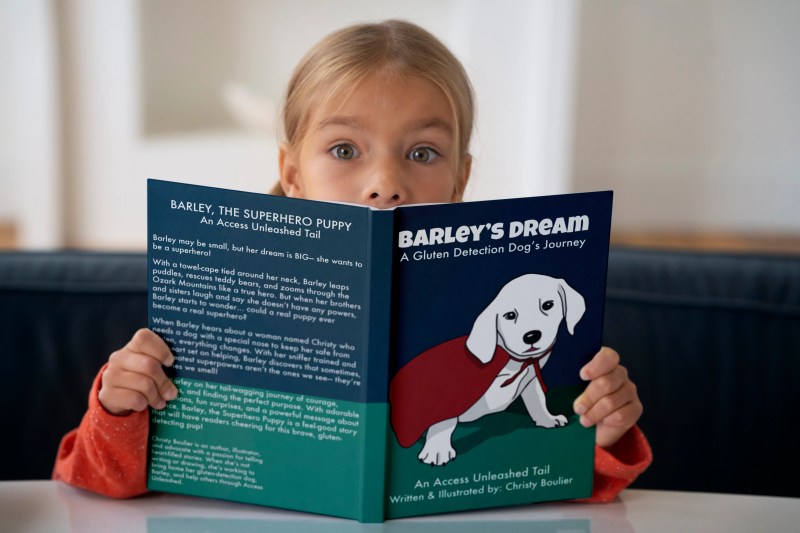
In Barley’s Dream from the Access Unleashed Tails series, Barley is a superhero-loving puppy.
She ties a towel around her neck like a cape. She rescues stuffed animals. She leaps over puddles and imagines saving the day.
Long story short, Barley worries that she doesn’t have any real superpowers.
Then she discovers a very special job.
Inspired by the true story of a gluten-detection service dog, Barley’s Dream introduces children to the way service dogs are trained and the people they help. Barley learns that being a hero isn’t always about flying or lifting something enormous.
Sometimes a hero uses a powerful nose.
Sometimes a hero notices what others miss.
Sometimes a hero helps one person feel safe enough to step into the world.

Barley’s story carries a message I hope children remember.
God created each of us with gifts and purpose, even when we’re still discovering what those gifts are.
That includes puppies.
That includes people.
When you see a service dog, remember these four steps.
Pause.
Stop before you reach, call, or move closer.
Look.
Notice the dog and handler without staring or pointing.
Listen.
Follow your grown-up’s directions and any instructions from the handler.
Give space.
Let the team work safely.
Pause. Look. Listen. Give space.
That’s service dog kindness.
Families can practice service dog etiquette before they encounter a working dog in public.
Ask your child what they might do if they saw a service dog at the library. Talk about how a dog can help someone without explaining the person’s private medical information.
You can also read Barley’s Dream together. The Barley’s Dream Activity Page offers another way to keep the conversation going through coloring, questions, and imagination.
For older children, the service dog etiquette guidance from Nationwide Children’s Hospital is a helpful family resource.
And if your family enjoys meeting story characters with four paws, visit Access Unleashed Tails to meet Barley, Sugar, Haven, Anchor, and Echo.
Different dogs.
Different missions.
The same heartbeat of hope.
A service dog helps make a wider life possible for the person at the other end of the leash. When children learn to respect that partnership, they help create a world with more kindness, more access, and more room for everyone to belong.
Until our next story,
Anna
Sharing Stories of Grace, Mystery, and Hope